
VIPER Request Signing
Sign a site's LLM requests with its notary key, send them straight to the upstream or through a Guardian gateway, and enroll the site as a Guardian agent.
VIPER signs the LLM requests a site makes, with that site’s notary key, so a Guardian gateway can
check who sent each request and what it carried. The site’s code does not change: the extension
picks up its fetch calls to LLM APIs, signs them and sends them itself, and the page gets an
ordinary Response back.
VIPER is turned on per site, in the popup, and only once the notary
is on for that site: it signs with the site’s notary key, the one the browser key certifies with
VCompBrowserOriginV1. Turning the notary off turns VIPER off too.
What gets signed
fetch POSTs whose path ends in one of these, from a site with VIPER on:
| Path | API shape |
|---|---|
/chat/completions, /completions, /responses, /embeddings | OpenAI |
/messages, /messages/count_tokens, /complete | Anthropic |
Every other request, and every request from a site with VIPER off, goes to the browser’s own
fetch untouched. XMLHttpRequest and requests made outside the page’s fetch are not signed.
The signature
The request is signed as the EQTY Guardian LLM gateway verifies it, its viper.v2 profile of
RFC 9421 HTTP message signatures:
Signature-Input: sig=("@method" "@target-uri" "x-viper-nonce" "x-viper-timestamp"
                      "content-digest" "x-viper-credential-cid"
                      ["x-viper-project-urn"] ["x-viper-upstream-url"])
                 ;alg="ecdsa-p256-sha256";created=…;keyid="did:key:zDn…"
Content-Digest:  sha-256=:…:, blake3=:…:
The signature goes through the notary’s sign, so it is made by the site key and recorded in the
audit log like any other signature. x-viper-credential-cid names the credentials that back it,
as JCS blobs:
- a self-issued
StateAttestation: the caller, the browser, whether the chain is anchored, and the request; - the site’s notary chain:
VCompTpmV1→VCompProcessV1→VCompBrowserOriginV1when anchored, the browser’s self-issued root when not; - through a gateway, the site’s registration credential and, with a project set, its project membership.
Direct and relay
| Mode | When | Where requests go |
|---|---|---|
| Direct | Guardian gateway is empty in VIPER settings | Straight to the upstream the page asked for, signed. Nothing checks the signature until a gateway is set. |
| Relay | Guardian gateway is set | The credentials are uploaded first (PUT {gateway}/v1/blobs/{cid}, signed), then the request goes to {gateway}/v1/relay, with the upstream in a signed x-viper-upstream-url header. The site is enrolled first. |
The response comes back to the page with these headers added, so the app can record what was signed next to what came back:
| Header | Value |
|---|---|
x-viper-keyid | The site key’s did:key |
x-viper-signature-input, x-viper-signature | The RFC 9421 signature |
x-viper-credential-cid | The credential CIDs, comma-separated |
x-viper-mode | direct or relay |
A page can ask whether its requests are being signed, without consent:
await eqtyNotary.viperStatus()
// { enabled: true, mode: "relay" }
Enrollment
Through a gateway, a site must be a registered Guardian agent before its requests are accepted. The extension enrolls it automatically on its first request, the way OpenShell’s supervisor enrolls a sandbox:
- The enrollment API key (VIPER settings) mints a provisioning token at
{control plane}/api/v1/agent-registration-tokens. - The gateway redeems the token at
/v1/agents/registrationsfor the site’s notary DID (409: already registered). - With a project set, the Integrity service issues the agent a 90-day
ProjectMembershipV1, which Guardian indexes. Requests then carryx-viper-project-urn.
The VIPER screen shows the site’s agent ID, or the error, with Enroll / Retry. The API key stays in extension storage and goes only to Guardian (control plane and gateway) and Integrity, never to pages; it is never shown again once saved.
Keys and agents
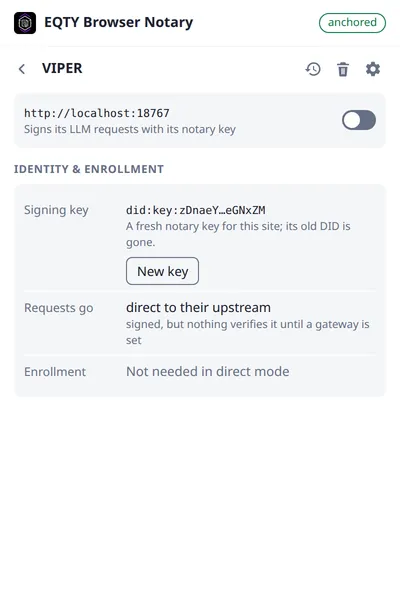
A site keeps its Guardian agent ID across key changes:
| Action | Where | Effect |
|---|---|---|
| New key | VIPER screen | The site gets a new notary key. The new DID joins the same agent with the API key (POST {gateway}/v1/agents/registrations with agent_id), keeping its project membership. The old key stays active in Guardian until an admin removes it (DELETE /v1/agents/{id}/keys/{did}). |
| New agent ID | VIPER screen | Forgets the agent; the next enrollment creates a new one through a token. |
| Join existing agent… | VIPER screen | Joins an agent made elsewhere as a replica, like viper did register --agent-id. A failed join leaves the site on its previous agent. |
| Agent ID to join | VIPER settings | The same for every site without an agent of its own, like VIPER_AGENT_ID. |
A replica joins with the API key, with no display name (it keeps the agent’s) and no app type (so a browser can join an agent of any app). The key’s owner must operate the agent.
Deleting a site’s VIPER data
The trash icon on the VIPER screen deletes everything VIPER holds for the site: its switch, its enrollment, its agent ID and its VIPER activity. Click it, then click again on Delete? within four seconds to confirm. The site’s notary key and permission stay; the agent stays in Guardian until an admin removes it.
Settings
The gear on the VIPER screen opens VIPER settings, which also lists the sites that have VIPER on.
| Setting | Default | Meaning |
|---|---|---|
| Guardian gateway | empty | Empty: direct mode. Set: relay mode, after enrolling the site. |
| Enrollment API key | none | A Guardian API key with the Register Agents scope. Leave empty to keep the saved key; Remove deletes it. |
| Agent ID to join | none | Sites without an agent of their own register as replicas of this agent. |
| Project | none | Enrolled sites get a 90-day membership in this project. |
| Guardian control plane | https://cp.guardian.dev.eqtylab.io, prefix /api | Mints registration tokens and indexes memberships, at {control plane}{prefix}/v1. |
| Integrity service | https://guardian.dev.eqtylab.io/integrityService | Issues project memberships. |
Limits
- No streaming. Responses are buffered: a server-sent-events body arrives in one piece, when the request completes.
- Request bodies must be under 10 MiB.
- A page that keeps its own reference to the original
fetchbypasses signing. A gateway refuses unsigned requests, so this only skips VIPER, it does not forge it. - Aborting the request with an
AbortControllercancels it in the extension too. A failure to sign or send rejects with aTypeError, as a network failure infetchdoes.